
A Wix site and a Shopify store end up running side by side more often than either platform’s marketing suggests — a Wix site handling marketing pages and a blog while Shopify runs the storefront, or a Wix storefront being phased out in favor of Shopify’s checkout and inventory tools. Either way, product names, prices, stock levels, or descriptions kept in both places drift apart the moment someone updates one and forgets the other. This guide covers how to sync Wix and Shopify without code, in either direction.
Why sync Wix with Shopify
Wix and Shopify overlap on e-commerce but serve different strengths — Wix for an all-in-one site with built-in marketing pages and a simple store, Shopify for deeper inventory, order, and app-ecosystem support at scale. Syncing the two lets you:
- Migrate a Wix Stores catalog into Shopify gradually, keeping both storefronts live and accurate during the cutover instead of a risky one-shot switch.
- Keep a Wix marketing site’s product showcase current from the Shopify catalog that actually processes orders, without re-typing listings twice.
- Run region- or brand-specific storefronts on each platform while sharing one underlying product catalog.
A one-time CSV export covers a single migration moment, but it doesn’t hold up once either catalog keeps changing — new products, price updates, or stock changes every week are the normal state for any active store.
What you need before you start
- A Wix site with a Wix Stores catalog (products, variants, inventory).
- A Shopify store with products shaped to match — title, price, SKU, inventory, images, and any custom fields.
- A Synquake account — sign up free at app.synquake.com.
No developer, no Wix Velo code, and no custom Shopify app required. Synquake connects to the Wix and Shopify APIs directly.
Step-by-step: connecting Wix and Shopify
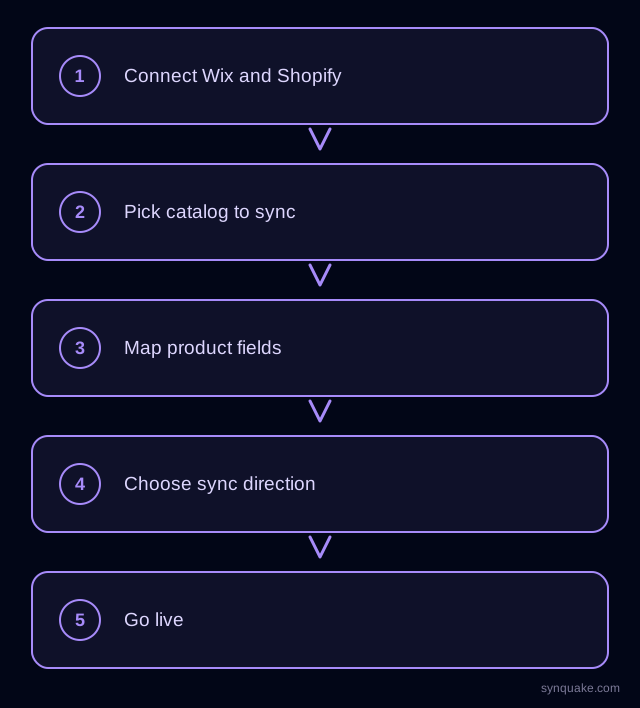
1. Connect both accounts
Add Wix and Shopify as connections in Synquake. Wix authorizes through OAuth from your site dashboard; Shopify through OAuth on the store you choose. No API keys get passed around the team manually.
2. Pick what to sync
Choose the Wix Stores catalog (or a specific product collection) and the Shopify store (or a specific product list) you want connected. Most teams start with the full product catalog, then narrow scope later if needed.
3. Map fields visually
Draw the connections between Wix product fields (name, price, SKU, inventory, images, description) and Shopify’s product fields. Field types don’t need to match exactly up front — Synquake handles the conversion, including Wix image galleries mapping to Shopify’s product images.
4. Choose sync direction
Pick one-way (Wix → Shopify, useful mid-migration while Wix stays the source of truth, or the reverse if Shopify is the system of record) or two-way sync, so a price or stock change made on either platform pushes to the other automatically. Two-way sync is included on every Synquake plan, not a paid upgrade.
5. Preview before going live
Run a preview sync against a handful of real products first. Confirm prices, SKUs, inventory counts, and images land correctly on the receiving side before enabling continuous sync.
6. Turn on live sync
Once the preview checks out, enable scheduled or real-time sync. From here, a price change, new product, or stock update on either platform flows to the other automatically, with no manual re-export step.
Common Wix–Shopify sync scenarios
- Phased migration: Move a Wix Stores catalog to Shopify product by product, keeping both storefronts live and accurate until the cutover is complete, instead of a single high-risk switchover.
- Marketing site + storefront split: A Wix site handles the marketing pages and blog while Shopify runs checkout — the two stay aligned on product details without a second manual entry pass.
- Multi-storefront catalogs: A brand running separate Wix and Shopify storefronts for different regions or audiences keeps shared product data consistent across both.
- Inventory accuracy: Stock changes on whichever platform actually fulfills orders sync to the other automatically, so neither storefront oversells a product that’s already out of stock.
Avoiding common sync problems
- Variant mismatches: Confirm Wix product variants (size, color) map to the matching Shopify variant structure before enabling two-way sync — mismatched variant options are the most common source of duplicated or orphaned listings.
- Duplicate products: Set a stable matching field (SKU or a shared product ID) so re-running a sync updates existing products instead of creating new ones.
- Image handling: Wix product images sync as URLs; make sure the Shopify side is configured to fetch and host them as Shopify product images rather than leaving broken links.
- Inventory source of truth: Decide which platform owns stock counts when both can sell the same item, so a sale on one side doesn’t let the other oversell before the sync catches up.
Beyond Wix and Shopify
Synquake’s sync is any-to-any across eight platforms — Airtable, Webflow, WordPress, Supabase (including Lovable-built apps), Wix, Shopify, Squarespace, and Google Sheets — plus CSV import/export on every plan. The same Shopify catalog you sync with Wix can also feed from an Airtable base, a Supabase table, or a Google Sheet, without building a separate integration for each. See the full integrations page for details, or read how it works for the connection, mapping, and monitoring model.
Related reading
- How to Sync Wix and Webflow Without Code
- How to Sync Wix and Airtable Without Code
- Shopify to Supabase Sync: Build a Real-Time Product Backend
Get started
Syncing Wix and Shopify without code takes minutes to set up and removes the manual re-entry step from a migration or a dual-storefront setup. Start your first Wix-to-Shopify sync free and preview it against real product data before going live.